If reports are correct, Republicans have finally won enough seats in the Colorado state house to claim a majority. Which means the coming session will feature a Democratic executive branch, a Democratic Senate, and a Republican House.
Eerie.
Wednesday, November 3, 2010


Midterms 2010: What Happened?

As loyal readers of this blog are no doubt aware, my forecast of the midterm election was pretty wide of the mark. We don't know the exact number of House seats the Republicans have gained yet, but it looks to be around 65 seats. (I've updated the scatterplot above using this figure.) I had predicted 40 seats, with a 28-seat margin of error. So, while 65 seats is within that margin, it's really out in the tails. And as the scatterplot above shows, it's a huge outlier. I am gratified somewhat that most other forecasters missed it by a lot, too, but the question remains: why did we miss this?
John Sides offers a bit of speculation. One thing he touches on is the importance of candidate recruitment -- the favorable political conditions for Republicans made it easier to recruit high-quality candidates this year. Contrast this with 1994. Yes, Republicans recruited heavily that year, as it was clear that conditions were running against the Democrats, but few believed that the GOP would really take the House that year until right before it happened. Democrats had held the House for forty years; a Democratic House was believed to a permanent part of the political environment. Today, we know that the House can flip back and forth. It was clear by mid-2009 that the economy wouldn't be expanding robustly any time soon, that unemployment was going to remain high, and that Obama's popularity wasn't likely to surge. Add to that the knowledge that a decent set of GOP candidates could actually flip the House, plus a nascent Tea Party movement that was producing potential candidates, and you have a great recruiting environment.
I'm not saying that's the only reason the GOP won so many seats, but it might contribute to it. I'm still wondering about other reasons. I can't help noticing, for example, that the four biggest outliers in the above scatterplot are from the last five midterm elections. Perhaps large swings are a feature of stronger partisanship, or nationalized elections, or something else. But the swings are getting larger.
Meanwhile, a spot of good news for my forecasts: I predicted that Republicans would take over 16 legislative chambers. It looks like they've taken 18, although there are still a few that are up in the air (including the Colorado House).

Tuesday, November 2, 2010
Final predictions
I have a bet with my colleague Peter Hanson over whose freshman seminar students can produce the best midterm forecasts. Here are the mean predictions for how many seats the Democrats will control in the House and Senate after tonight:
House Senate
My class 204 50.5
Peter's class 217 51.25
Me 217 52
I'm guessing Peter has more liberals in his class than I do.
House Senate
My class 204 50.5
Peter's class 217 51.25
Me 217 52
I'm guessing Peter has more liberals in his class than I do.
Monday, November 1, 2010
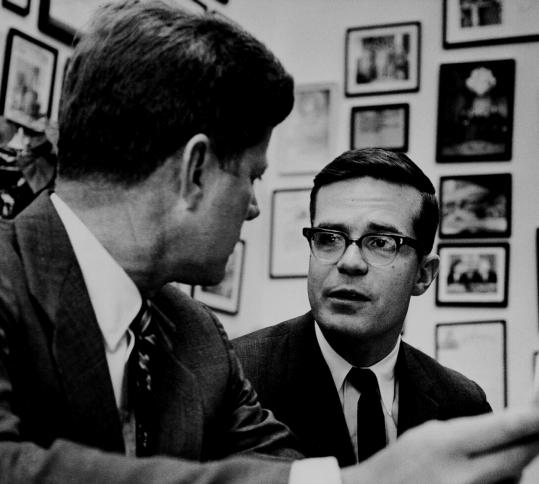
Ted Sorensen

America's funniest moral scold
I ended up showing Jon Stewart's closing rally speech to both my classes today. While I disagree with Charli Carpenter that this will someday be seen as one of the Great American Speeches, it's a very good speech, and one whose content merits some reflection.
The speech was very much in line with some of Stewart's earlier reflections on needless partisanship in the media, particularly his epic Crossfire appearance. The main argument, that people who disagree should still be nice to each other, is hardly controversial. But he goes beyond that, saying that we really do need more comity in government, that excessive partisanship is hurting the country. As he said on Saturday:
A friend of mine (Hans Noel - see comments) also pointed out that the Jon Stewart at the rally would have some real disagreements with the Jon Stewart who interviewed President Obama last week. The latter Stewart was criticizing Obama for compromising too much on health care reform and other policy matters. He apparently wanted Obama to be more confrontational, regardless of how that affected the tone in Washington, because he thought the outcome was important.
And there's the rub. We always want politicians to be nicer to each other, until they're arguing about things we hold dear, and then we want them to fight tooth and nail for those things.
So, okay, he's being a little ideologically inconsistent here, but he's no worse than the rest of us. And I'm willing to grant some slack to the guy who created a battle of the bands between Ozzy Osbourne and Cat Stevens.
The speech was very much in line with some of Stewart's earlier reflections on needless partisanship in the media, particularly his epic Crossfire appearance. The main argument, that people who disagree should still be nice to each other, is hardly controversial. But he goes beyond that, saying that we really do need more comity in government, that excessive partisanship is hurting the country. As he said on Saturday:
We hear every damned day about how fragile our country is, on the brink of catastrophe, torn by polarizing hate, and how it's a shame that we can't work together to get things done. The truth is, we do! We work together to get things done every damned day! The only place we don't is here [the Capitol] or on cable TV!
But Americans don't live here, or on cable TV. Where we live, our values and principles form the foundation that sustains us while we get things done--not the barriers that prevent us from getting things done.He then goes on to draw a rather creative metaphor of cars entering a tunnel, who still manage to merge from 20 lanes to two despite their various disagreements. But this is a false analogy. Liberals and conservatives can merge lanes, or work together in an office, or live together as neighbors because those tasks have very little to do with being liberals or conservatives. Those philosophies are governing philosophies. We should not expect liberals and conservatives to get along when making governing decisions the way they do in other aspects of life because those decisions are essential to what it means to be a liberal or a conservative. Compromises are, in some sense, betrayals. When a liberal adopts a conservative policy stance, she has made herself less liberal in the process, and she has disappointed or even betrayed her cohort. Yes, sometimes governing requires compromise, but it's quite another thing to suggest that ideologues should compromise for the sake of creating a more agreeable work environment.
A friend of mine (Hans Noel - see comments) also pointed out that the Jon Stewart at the rally would have some real disagreements with the Jon Stewart who interviewed President Obama last week. The latter Stewart was criticizing Obama for compromising too much on health care reform and other policy matters. He apparently wanted Obama to be more confrontational, regardless of how that affected the tone in Washington, because he thought the outcome was important.
And there's the rub. We always want politicians to be nicer to each other, until they're arguing about things we hold dear, and then we want them to fight tooth and nail for those things.
So, okay, he's being a little ideologically inconsistent here, but he's no worse than the rest of us. And I'm willing to grant some slack to the guy who created a battle of the bands between Ozzy Osbourne and Cat Stevens.
Subscribe to:
Posts (Atom)